
I left the lunch stop for the Buddhist-led Walk for Peace in south DeKalb a couple of hours ago, and the experience is still settling in—quietly, persistently, like a stone dropped into water whose ripples have not yet reached the shore.
The monks arrived a bit late, which unexpectedly opened space for conversation. I waited inside the Porter Sanford III Performing Arts & Community Center, where the monks would eat. Hundreds of others waited outside in the cold. I chose warmth—and proximity to the organizers—because listening, in that moment, felt like the work I was meant to do.
Inside, I spoke with Winlet, one of the lead organizers. She lives in Texas and coordinates the immense logistics of the walk: where the monks stop, eat, rest, and gather. We had spoken by phone earlier in the week about possibly hosting the monks at Atlanta Friends Meeting, but they needed—and had found—something closer to Clarkston. When I asked about their hopes upon arriving in Washington, D.C., she shared that the monks would like to have an audience with Trump at the White House. Given his appetite for media attention and his long-stated interest in the Nobel Peace Prize, it would not surprise me if such a meeting happened. I was tickled by the thought that this message of peace—moving steadily along the eastern half of the United States, and perhaps even reaching the White House—is being borne by immigrant religious leaders of a minority faith.
It was an honor to go behind the scenes and witness the quiet grace unfolding all around us, as scores of volunteers prepared food with care, urgency, and devotion.
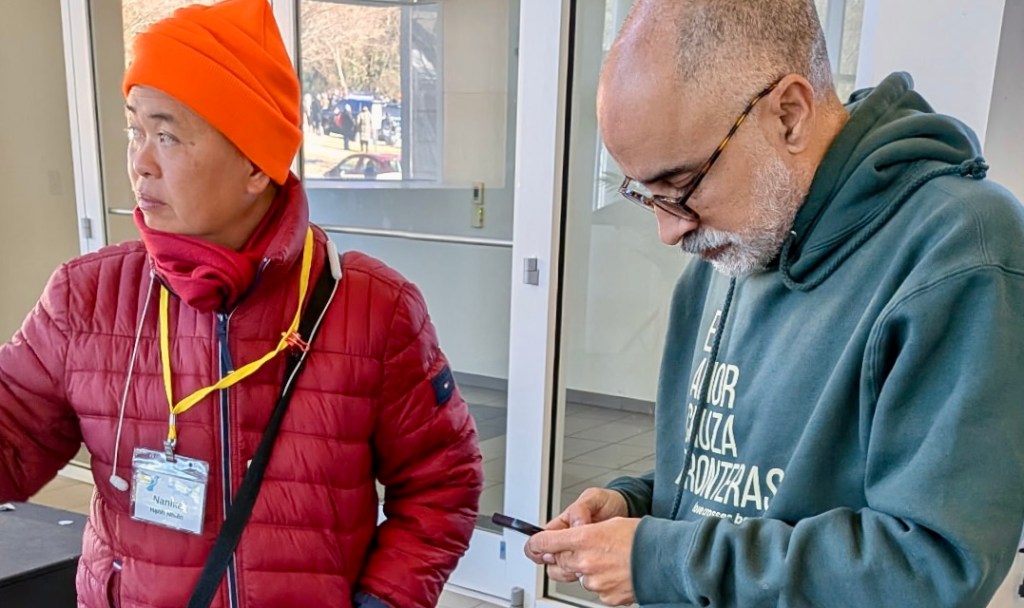
I knew there was no way everyone would be fed. The food was indoors; the crowds were not. So I was humbled and surprised to be among the first offered a plate after the monks—a delicious sampler of Southeast Asian cuisine. I ate modestly, wanting to embody abundant generosity and radical trust in the economy of loaves and fishes. Even there, the practice of peace felt tangible: restraint, gratitude, awareness of others.
Over lunch, I shared a rich conversation with three men. John, a Korean-American guest of mine, is on his own peace pilgrimage—traveling from New York City toward Latin America. David, a videographer and seminary graduate, helped me think through the ethical and practical use of body cameras in cultivating a just and peaceful presence at the gates of ICE. And Minh, a young man from Vietnam now living in South Metro Atlanta, became a companion in the simplest and most human of ways. We “broke banana” together and spoke of our shared love for the teachings of Thich Nhat Hanh.
One of his teachings felt especially alive in that moment:
Peace is every step. It turns the endless path to happiness into a reality here and now.
Their commitment to peace was evident in every gesture, but what struck me most was the handful of monks I saw walking barefoot—even on this cold morning in the 20s. In those steps, I witnessed a living symbol of their desire for simplicity, detachment, and mindful presence, hallmarks of the Vipassana practice of Theravada Buddhism. I found myself resonating with and humbled by their embodiment of values I hold dear as a Quaker: patience, restraint, and the discipline of letting peace move through the body before it reaches the world.
When the monks finished lunch, they returned outside, and Venerable Bhikku Pannakara addressed the crowd. In a soft, grounded voice, he spoke of peace as a ripple—a reverberation that begins in our own hearts and extends outward to all living beings in the universe. He invited us to begin each morning by writing the words, “Today is going to be my peaceful day,” then to sit with them, speak them aloud, and carry them through the hours that follow.

He was not naïve. He knows that this pilgrimage alone will not bring peace to the world. But if each of us were to become a living pilgrimage of peace—if peace were practiced in our bodies, our speech, our restraint, our courage—then collectively, something real might yet emerge.
I left knowing that peace is not primarily something we demand from power or petition from institutions. It is something we practice, step by step, until our lives themselves become the path.
written by Anton Flores-Maisonet
At The Threshold
What would it mean for my life to become a living pilgrimage of peace, where each step, word, and choice deepens the peace I carry into the world?

 Casa Alterna
Deep thanks, dearest Anton!! Am gratefully awaiting their arrival in our area….am not very techy so have not been able to be in touch to ask questions about where and when….tried the phone number they had listed, and…nothing:( (Would welcome any suggestions!) Ever grateful for all you all are, and do!! Jean
LikeLike