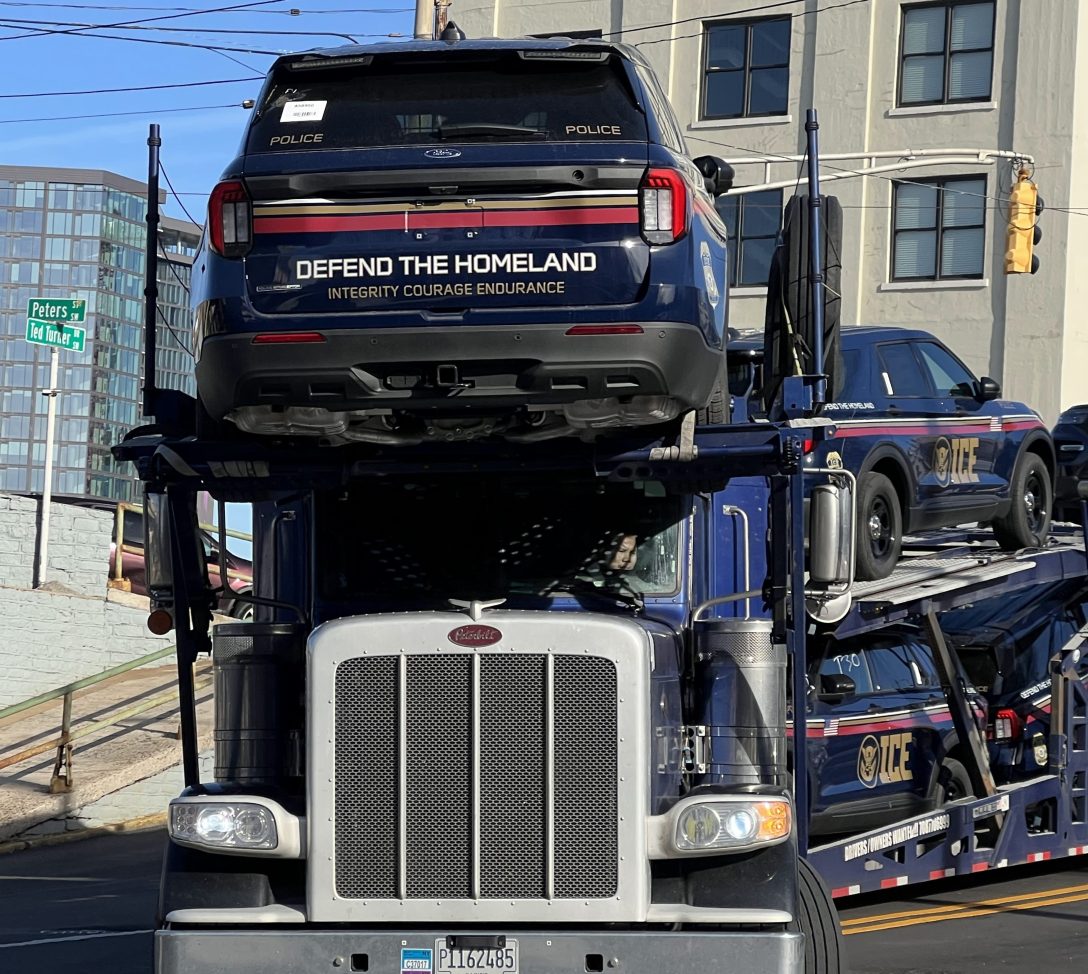
As we wrapped up our morning shift outside the gates of the Atlanta ICE office and I started towards my car, I suddenly stopped in my tracks, aghast at the car carrier slowly making a wide turn in front of me. I took out my phone and snapped photos of the truck delivering the brand new ICE SUVs, each one inscribed with “Defend the Homeland,” in large bold letters both on the side and across the back. It took me a minute to register what I was feeling as I took in the sight in front of me.
As someone who studied English, and then went on to study Theology, I have spent a good deal of my academic life considering the power of word choice, whether it was in a poem, an essay, or a biblical text. The more I considered it, the more I recognized the deepest source of my discomfort and moral dissonance stemmed from the phrase: “Defend the Homeland.” The use of the verb “defend,” begs the questions, whom are we defending against, and whose defense are we coming to? Are we defending against the 86-year-old man I met as he and his wife, who used a walker, slowly and gingerly approached the door to report at the ICE office? Is it the scores of small children our volunteers encounter each day, bundled up on the sidewalk waiting to be let in to their appointments? Is it the younger brother with down syndrome who smiled ear to ear when I handed him a teddy bear while he and his family approached the building?
Each morning that I lead volunteers outside of the ICE office, I encounter people and listen to their stories. They are stories of courage that are often laced with confusion and disbelief that they are considered dangerous, or that they are the ones ICE agents are here to defend against. I wonder if the ICE Agents consider themselves defenders when they meet the people coming for their appointments, often elderly or very young. I find myself wondering how they understand their work as defense when families are separated or loved ones are taken into custody.
The second part of the phrase equally unsettled me. The word “homeland” lingered. At the time the Department of Homeland Security was created, even then–Defense Secretary Donald Rumsfeld noted that the word “homeland” felt unfamiliar in American civic language. As I pondered the word choice of homeland, immediately I wondered to myself, what makes a place someone’s home? Followed by, who gets to decide that? What right to this land do I have beyond those people who immigrated here more recently? The lyrics to “This land is your land,” played in my head. This land is your land and my land, but ultimately it is not ours to possess. As I expressed some of these thoughts to the volunteer standing next to me, she quickly added that the land we are on is in fact indigenous land. She also shared that some indigenous friends of hers who live in Minneapolis have been carrying their passports, afraid of being racially profiled and targeted by ICE.
As a person of faith, one of my deepest convictions is that we are all children of God, and thus, we are all one human family. Another deep conviction of mine is that this earth is a gift from God that we are blessed to inhabit and must treat with great reverence. When I consider these beliefs, it feels arrogant to describe any part of this earth as my homeland as opposed to someone else’s, or to assert ownership over creation. The refrain that I will keep singing instead is that truly, this land was made for you and me.
Written by Bernadette Naro, Program Director

 Casa Alterna
Gratitude beyond all words, for all you all are, and do, dear Anton… Always, Jean
LikeLike