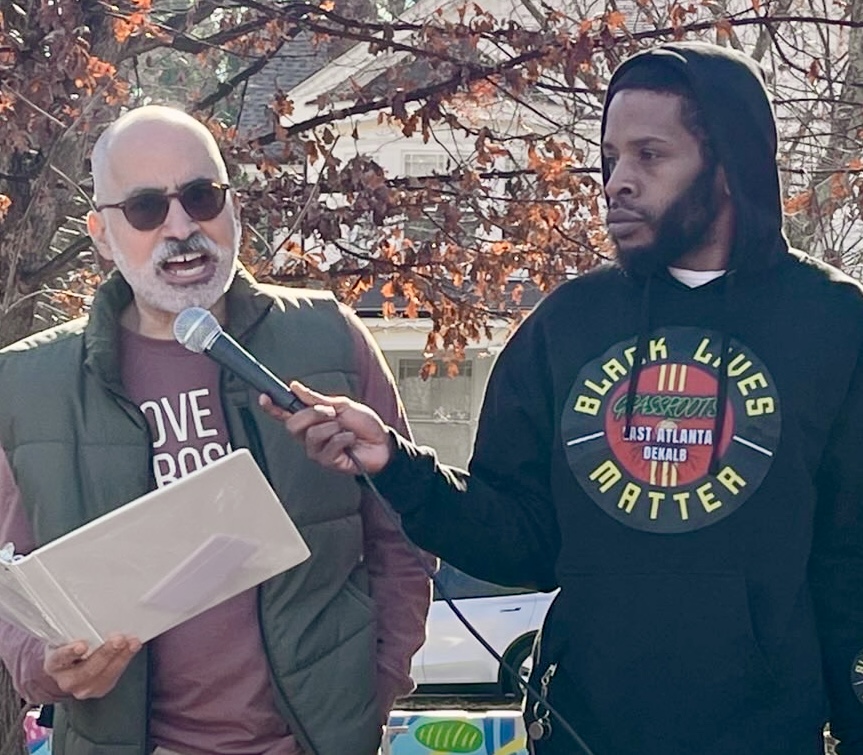
Anton Flores-Maisonet delivered this speech on January 4, 2026, at Piedmont Park in Atlanta during a public protest against the Trump administration’s military operation in Venezuela. That operation resulted in the capture of President Nicolás Maduro and raised alarm about U.S. intervention, violations of international law, and another potential “war for oil.” Demonstrators gathered in solidarity with the Venezuelan people and in opposition to U.S. imperialism. The remarks that follow are shaped by Casa Alterna’s accompaniment of Venezuelan asylum seekers and others living with the consequences of displacement, detention, and deportation. They reflect a shared conviction that dignity and democracy cannot be imposed by force, but must be practiced through presence, accountability, and love.
Friends—thank you for being here.
As historian Timothy Snyder reminds us, “Power wants your body softening in your chair and your emotions dissipating on the screen. Put your body in unfamiliar places with unfamiliar people. Make new friends and march with them.”
We are here today because we choose presence over passivity—because being together, in public, still matters.
Each week, I stand with Casa Alterna volunteers in solidarity with asylum seekers outside the ICE field office where they must report. People come hoping compliance will bring safety—that following the rules will protect them.
Disproportionately, many are Venezuelan asylum seekers—people who have endured years, even decades, of hardship. They carry the weight of political repression, economic collapse, and daily uncertainty.
What we have learned at those gates is clear:
those who follow every rule are often the most vulnerable.
They attend every check-in.
They trust the process.
And instead of protection, they encounter relentless surveillance, indiscriminate detention, and manufactured fear.
Many still hope this moment could mark a turning point—that democracy might mean something, that due process might hold.
But the pattern we are witnessing tells another story.
It follows a pipeline we need to name.
Displacement.
Venezuelans did not leave their homes willingly. They were pushed—by repression, scarcity, and international forces, including U.S. policies that claim to defend democracy while undermining it.
Dehumanization and demonization.
Once here, people are no longer described as families or neighbors. They are labeled threats, criminals, symbols of fear. History shows where this language leads.
Detention.
The United States maintains a for-profit immigration detention system. Families are separated. Human suffering becomes a business model.
Deportation.
Not only back to Venezuela, but to third countries—sometimes into prisons where human dignity is stripped away.
And domination.
Unilateral actions—like those we are protesting today—that sidestep democratic norms and international law, driven by control and profit rather than accountability.
At every stage of this pipeline, something essential is missing:
Dignity.
Democracy.
Due process.
Missing abroad.
Missing at the border.
Missing inside detention centers.
Missing when decisions are made without transparency or accountability.
There is no moral justification for illegal, unilateral tactics that manipulate hope and fear.
As a Puerto Rican, I recognize the shape of what happens when powerful nations exploit vulnerable people for resources and control. It has a name. Neocolonialism. And we should be honest about it.
But I am not here only to name what is broken.
I am here to name what is already being practiced—and what is still possible.
I speak on behalf of Casa Alterna, a nonprofit I founded, rooted in community and accompaniment. For twenty years, we have lived by one conviction:
Love crosses borders.
Since 2020, we have welcomed over 600 asylum-seeking guests from more than 50 countries, including Venezuelans fleeing the forces I’ve described.
That love shows up as emergency shelter, long-term communal housing, groceries, shared meals, and shared humanity.
And now, as detention and deportation intensify, it shows up through our Compas at the Gates of ICE—offering legal resources, food, blankets, umbrellas, and our presence. We stand with people. We bear witness. We refuse to let cruelty happen quietly.
My Venezuelan friends are not asking for pity.
They are asking for the chance to live with dignity.
They save for costly asylum cases while sending what they can to loved ones back home. Conversations happen through encrypted messages—sometimes in code—out of fear. And still, they hope.
So I ask:
Do we dare move beyond slogans and shouts into solidarity—knowing that real solidarity will change us?
Do we dare listen to asylum seekers themselves, and not just speak about them?
Do we dare confront systems that make suffering predictable and profitable?
Because when we walk this path together—
from downtown ICE offices,
to detention centers like the one proposed in east metro Atlanta,
to deportation flights,
to Caracas— we are not just resisting injustice.
We are insisting on dignity.
We are insisting on democracy.
We are insisting that love—not fear—gets the final word.
And that is a future worth standing up for.

 Casa Alterna